I am a master’s student in Computer Science and Engineering at UC San Diego (Class of 2027). Before UCSD I studied Computer Science at Wuhan University (B.Eng., 2021–2025) and spent the fall of 2023 at UC Berkeley on exchange. My interests are robotics software, lab automation and agent systems: control loops on real hardware, and the tests and logs that make them repeatable. Recent work includes closed-loop waypoint navigation on a Rubik Pi rover, workload modeling for Transformer inference on edge FPGAs at ICSLAB, Wuhan University, and linear probing of a text-to-music diffusion model.
Projects & Research
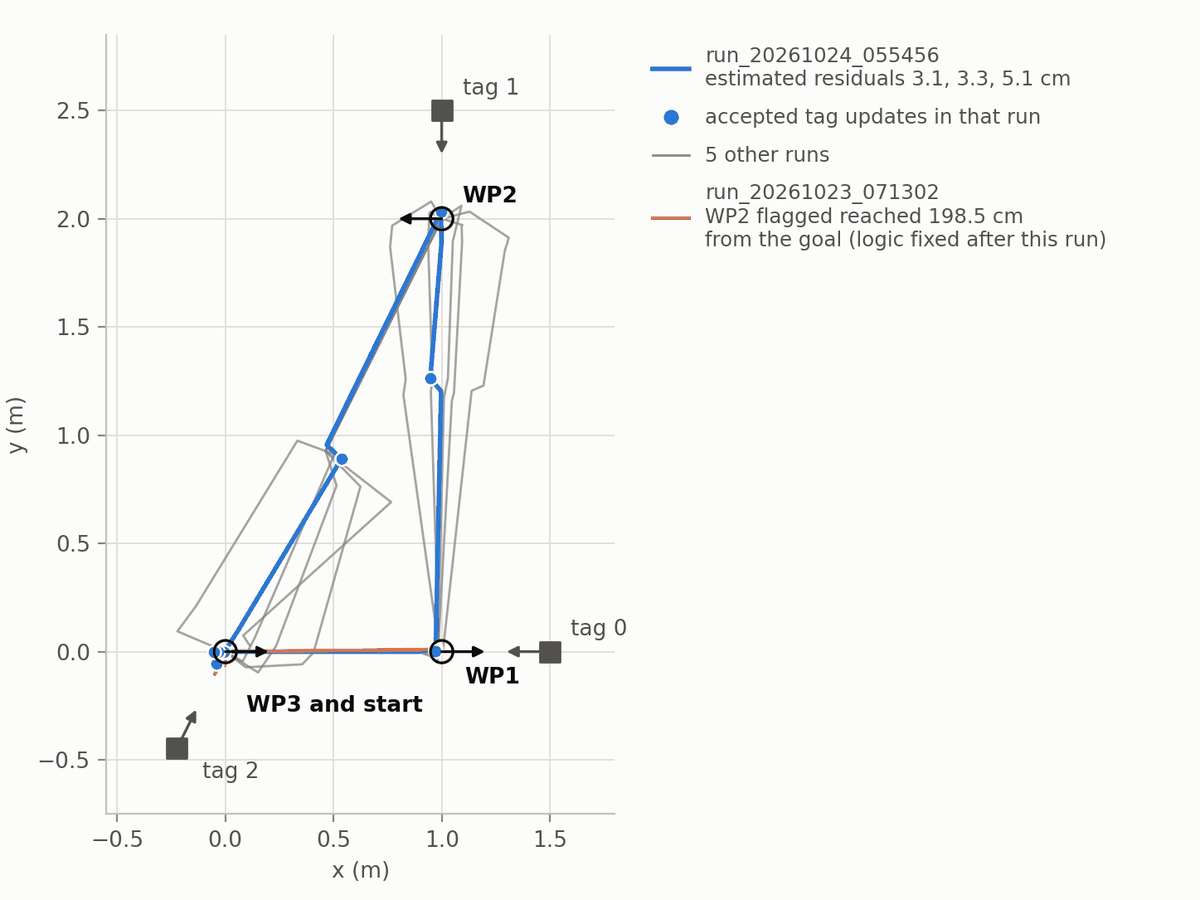
Estimated paths of the 7 runs flagged complete; the best run is highlighted. Filter estimates, no external ground truth.
Closed-loop waypoint navigation with AprilTag landmarks
A small rover drifts when it executes motion primitives open-loop, so after every primitive it stops, observes AprilTag landmarks, updates an SE(2) extended Kalman filter with chi-square gating, and replans. A fine spin-calibration level cut the smallest executable turn from about 24° to 3.05° (CCW) and 4.55° (CW). Across 24 archived runs, the best run ended with estimated residuals of 3.1, 3.3 and 5.1 cm at the three waypoints (filter estimates, no external ground truth). The navigator does not depend on ROS and passes 93 offline test cases against a simulated rover with systematic error; the 24 runs logged 184 landmark observations, 42 of them rejected with the reason recorded.
ICSLAB, Wuhan University, 2024–2025
Workload modeling and scheduling for Transformer inference on edge FPGAs
Non-linear Transformer operators are costly on FPGAs, and their resource demands are hard to schedule together. I simplified the operators with low-order polynomial approximation and integer quantization (after I-BERT), and modeled scheduling as integer nonlinear programming over resource vectors and a task dependency graph, solved by dynamic programming. In simulation the best static configuration, Fix(18,2,2,2), averaged 18.39% longer inference time than the dynamic-programming schedule. I also lead-wrote, on the PI’s behalf, the lab’s NSFC Young Scientists Fund (Category C) proposal.
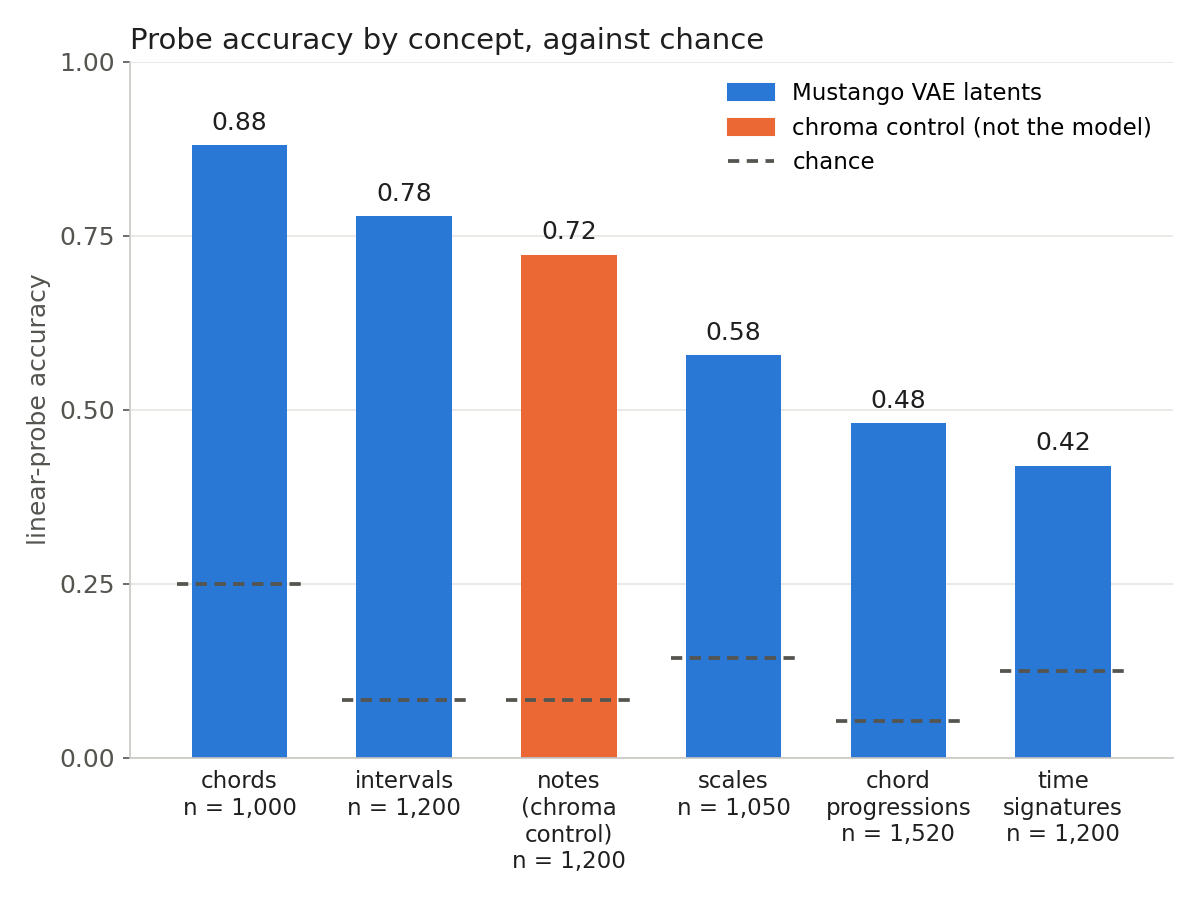
Linear-probe accuracy by concept against chance, from the submitted notebook (section 2.2 table); the notes bar is a handcrafted chroma control, not the model. Tempo, a regression task, reached R² 0.74.
Probing music-theory concepts in a text-to-music diffusion model
Does a latent-diffusion music generator encode music theory in its intermediate representations? Adapting the SynTheory probing method, I trained linear probes on Mustango’s VAE latents and UNet activations over a 17-run sweep of layers and diffusion timesteps. Chord-type accuracy reached 0.88 on 1,000 clips (chance 0.25), while pitch-class accuracy from VAE latents stayed near chance (about 0.10 against 0.08) even with frequency-preserving pooling. A handcrafted chroma control on the same split reached 0.72, so the bottleneck is in the latent representation, not in the pooling.
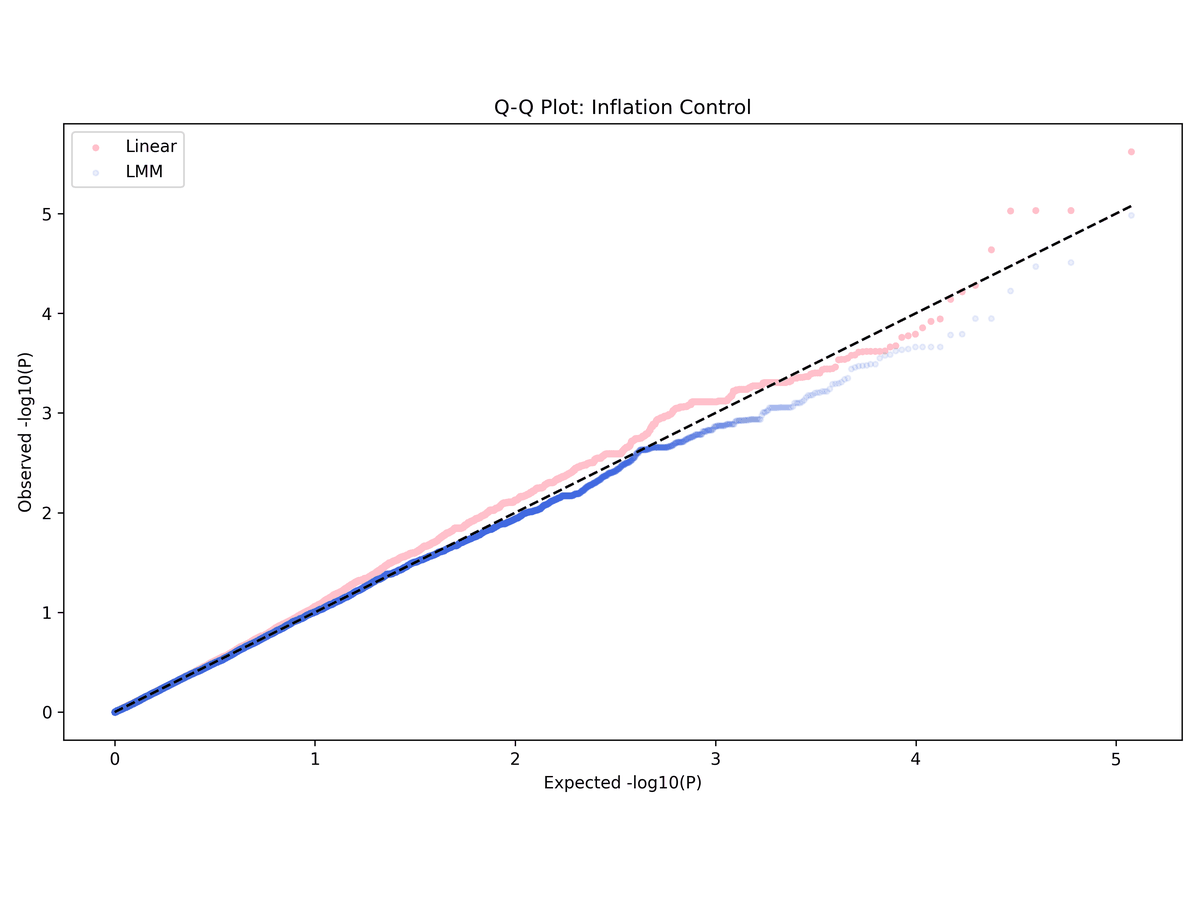
Q-Q plot of observed against expected p-values for both methods on 118,836 variants, from the repository's results/plots.
A reproducible GWAS pipeline: linear regression versus linear mixed model
Population structure inflates association statistics, so this pipeline takes 1000 Genomes CHB chromosome 22, simulates a trait from 20 causal variants (seed 42), and runs PLINK linear regression against a GCTA linear mixed model, reporting λGC with Manhattan and Q-Q plots. An interactive driver checks the environment, runs the five steps in order, and retries or skips a failed step. Both methods gave λGC close to 1, a small change on a cohort that was already well mixed, so the run is a check of the pipeline rather than a demonstration of the mixed model’s advantage.
Education & Awards
| UC San Diego M.S. in Computer Science and Engineering, GPA 4.0/4.0 | Sep 2025 – 2027 (expected) |
| Wuhan University B.Eng. in Computer Science and Technology, GPA 3.87/4.00 | Sep 2021 – Jun 2025 |
| UC Berkeley Exchange student, Berkeley Global Access, GPA 4.0 | Aug – Dec 2023 |
- NOIP 2019, First Prize, Shanxi Division (ranked 10 of 293)
- CCF CSP, top 10%
- Luojia Excellence International Exchange Scholarship, Wuhan University, 2024 (RMB 50,000)
Contact
Email is the best way to reach me: s7yuan@ucsd.edu. Code is on GitHub. A one-page résumé is linked as CV in the left column; a Chinese version is at the end of this page.
中文摘要
袁盛琪,UCSD 计算机科学与工程硕士在读(2027 届),本科武汉大学。方向:机器人软件、实验室自动化、智能体系统。做过:Rubik Pi 小车 AprilTag 闭环航点导航(方案设计、标定、实车验证,进行中);边缘端 Transformer 推理调度(最优静态配置 Fix(18,2,2,2) 的平均推理时间比动态规划调度方案高 18.39%;受托主笔青年科学基金申请书);Mustango 乐理探测(和弦 0.88,随机 0.25);GWAS 流水线(PLINK 对 GCTA)。中文简历(PDF)